Modeling uncertainty in exam scores
November 9, 2020
We widely use exams in education to gauge the level of students. The result of an exam is really only indicator of the students actual level, and has a certainly level of uncertainty. In this article we will try to model the uncertainty in the grades of an exam through a Bayesian model, using the amount of points obtained in each question. Such an analysis may be useful in designing good exams, as in principal this error is something we would wish to minimize.
The data
We will use scores for 8 individual questions of a university math exam. We recorded scores of 100 students. Each question is worth 12 points for a total of 96 points, and students could obtain anywhere between 0 and 12 points for each question.
Notice: this data is modified from the original in multiple ways due to privacy reasons. The modifications preserve most qualitative statistical properties._
Modeling the data
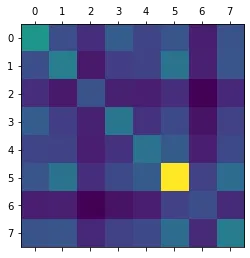
Let denote the total exam score, and let denote the score obtained for the th question. Obviously these variables are not independent, high scores in one question are a indicator the student will get high scores in another question as well. For simplicity we want to model the question scores as conditionally independent given the total score . The idea behind this is that is an unbiased measurement of the students abilities, and the score obtained for a question should only depend on the student’s abilities. This ignores the fact that some questions test similar aspects of the course, and so are more correlated compared to others. If we plot the covariance matrix of the scores we see that there doesn’t seem to be a strong correlation between question scores. We do however see that the 6th question has a higher variance than the other questions
Now we need to obtain a good model for the conditional probability . We will model by a binomial distribution, which corresponds to assuming consists of ‘subproblems’, of which the student has equal chance of solving. While this does not seem like a natural assumption, it is very convenient. If denotes the total score obtainable for question this gives model
with
Next we need to model the conditional distribution . We tried linear and quadratic regression on , but this tends to perform badly near the limits and , and in general tends to shift the predictions towards the global mean. Instead we want a model such that if then is concentrated near zero. To do this we model with a beta distribution, whose parameters depend quadratically on . More precisely if (which supported on ), then we set
where is a small regularization parameter. This model has constrained close to if is small (and similarly if close to 96), and also has enough flexibility to fit our data reasonably well. The exponentials are used both to force the parameters to be positive, and this parametrization also improves the fit. The parameters are given normal priors with mean and large sigma, although the fit is not sensitive on this prior.
We will model all the parameters in this model using a Monte Carlo Markov Chain (MCMC) simulation
using pymc3. With pymc3 it is very straightforward to implement this model, and requires only a
couple lines of code. In the end we obtain samples for the variables , and we can model the
error in the total score by looking at the distribution of the posterior .
Results
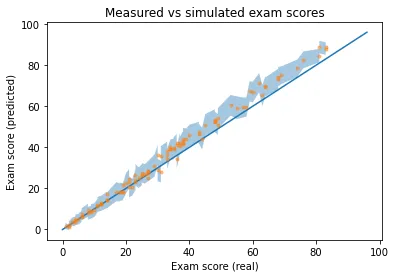
First we compare the distribution of the predicted exam scores to the actual exam scores. The graph below shows the real scores on the horizontal axis, and predicted scores on vertical axis. The vertically shaded area indicates one standard deviation. The model appears to by unbiased for lower scores, but picks up a slight bias for higher scores. In the original unmodified data this behavior was not apparent, and is therefore likely a byproduct of how the data was modified due to privacy concerns.
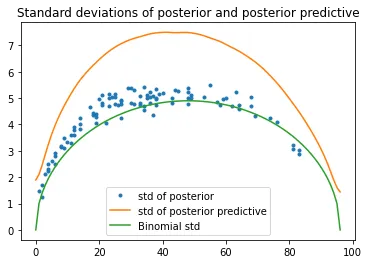
The goal of this project is to simulate the error in the exam score. Below we plot the the standard deviations of the predicted scores as function of total score. We compare this to a theoretical variance coming from a binomial distribution with 96 trials, and we see that the error is close to this theoretical variance. This means that most of the variance in posterior comes directly from the binomial distributions modeling the question scores . We also plot the the variance in the posterior predictive, which is significantly higher. This makes sense, because for the posterior predictive we do not just model the error in each question score, we also have to predict the scores for each question given just the total score.
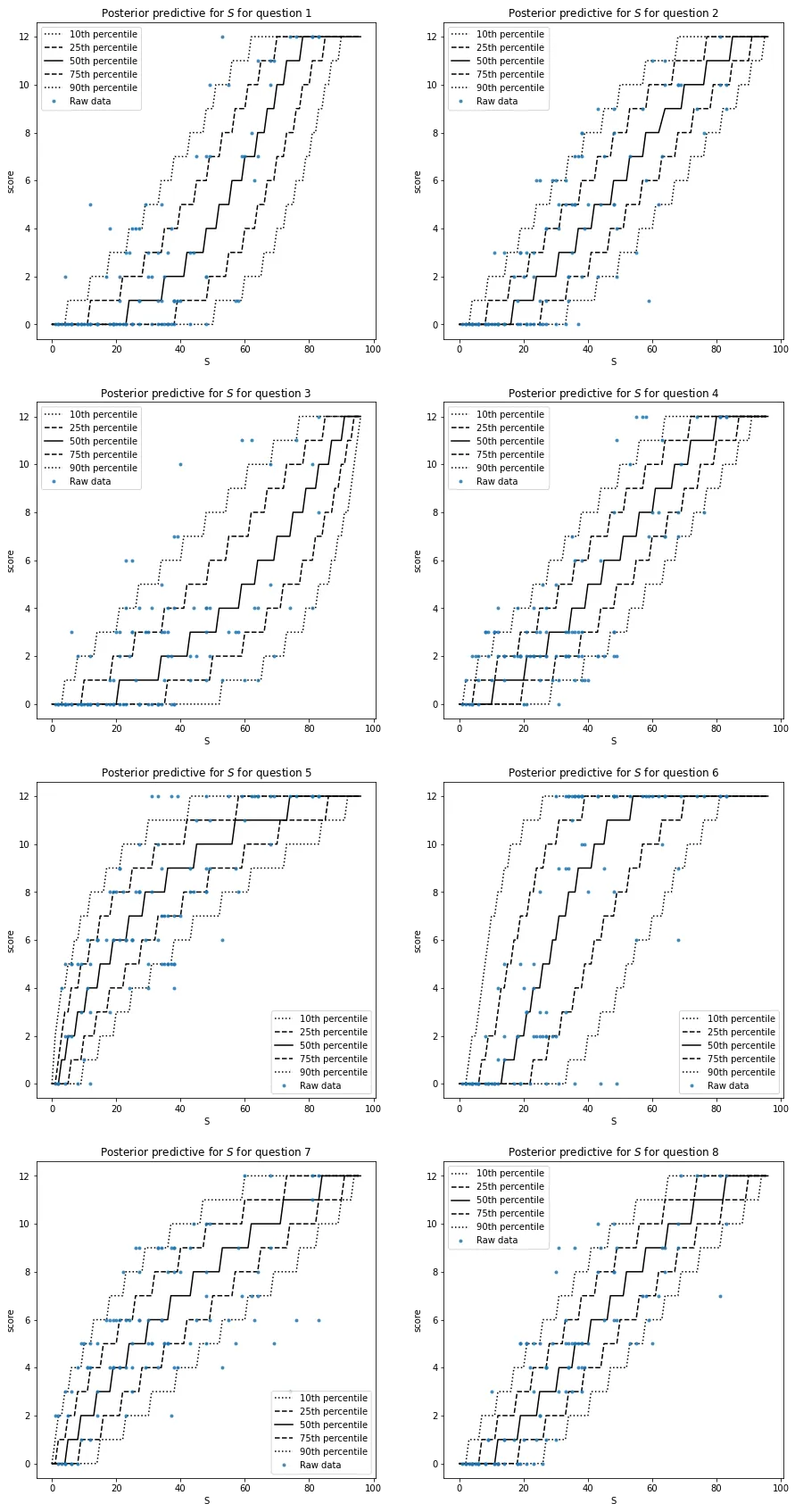
To measure how well our model describes the data, we compare the posterior predictive for each question to the data for each question as function of total score. Here we see that our model describes the distribution quite well for most questions, although in some questions the model underestimates the spread of the data. This is likely because the binomial model is not accurate. To model the questions scores more accurately we would need to step away from the binomial model. However this would make the model more complicated, and the current model does give reasonable predictions for the most part.
Evaluation the qualities of questions
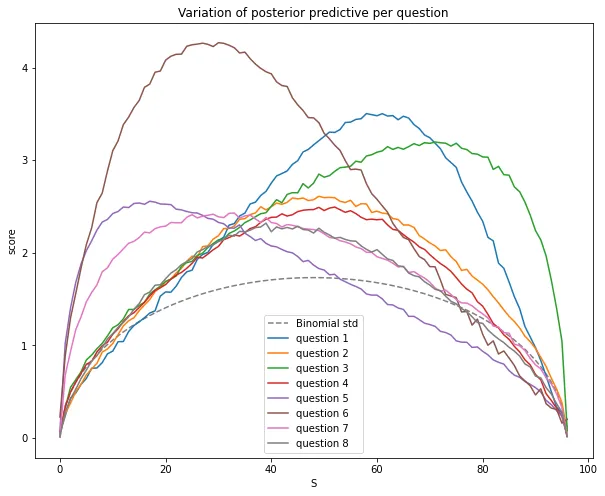
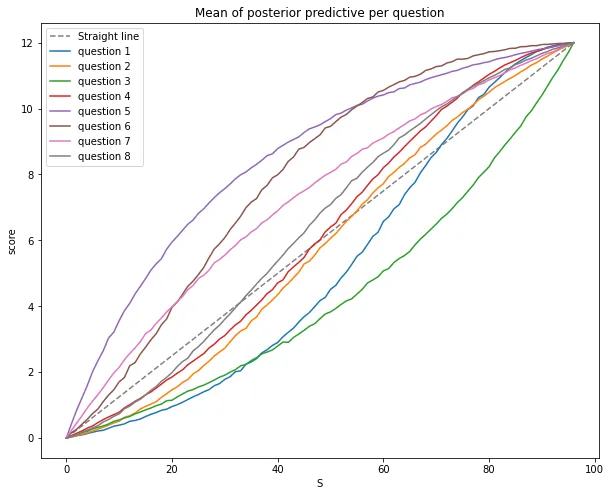
We can also use the posterior predictive to qualitatively evaluate the quality of questions. Let us plot the standard deviation and mean of the posterior predictive for each individual question as function of the total score below. In a perfect question the variation is as low as possible, and the mean should be relatively close to the straight line. All in all this means that the question provides as much information about the students abilities. Based on this it seems that questions 2,4,8 are quite good, whereas 1,3,6 are not as good. In particular the points obtained for question 6 has the weakest correlation with the total score. Question 5 seems to have been relatively easy, whereas question 3 appears to have been difficult. Analyzing questions in such a manner can be useful for designing future tests, as well as determining what aspects of the course the students found easier or more difficult.
Keep reading

13th of February, 2021
I have 15 years worth of email traffic data, let's take a closer look and discover some fascinating patterns.

26th of August, 2020
Cross validation is extremely important, but how should we choose the size of our validation and test sets?
10th of August, 2020
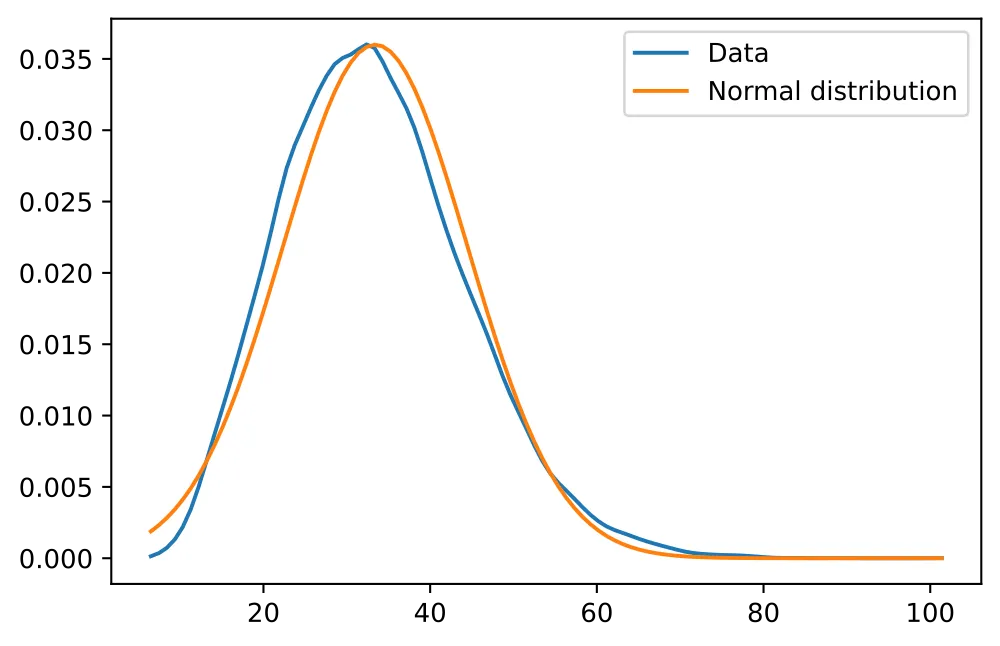
Normally distributed data is great, but how do you know whether your data is normally distributed?
7th of October, 2023
In my first dive into Rust, I implemented an unscented Kalman filter in and made it 20x faster than the equivalent Python implementation.

1st of May, 2023
I made an interactive dashboard for this website, and here is the story of how I did it.

12th of August, 2020
I use last.fm to track my music listening. Let's look at my data to discover how my musical preferences evolve over time.

20th of June, 2020
Judging in figure skating is biased. Let's use data science to figure out just how bad the issue is.

15th of January, 2025
I made an array programming language as a language extension to Rust

1st of August, 2024
Self-hosting your own cloud services not only saves money, it is also a great way to learn

26th of February, 2023
Read this blog post if you're curious what I worked on during my PhD!
29th of March, 2022
Linear least-squares system pop up everywhere, and there are many fast way to solve them. We'll be looking at one such way: GMRES.
10th of March, 2022
We recently made a paper about supervised machine learning using tensors, here's the gist of how this works.
26th of September, 2021
A lot of data is naturally of 'low rank'. I will explain what this means, and how to exploit this fact.
29th of August, 2021
Parsing and editing Word documents automatically can be extremely useful, but doing it in Python is not that straightforward.

31st of May, 2021
Finally, let's look at how we can automatically sharpen images, without knowing how they were blurred in the first place.
2nd of May, 2021
Deconvolving and sharpening images is actually pretty tricky. Let's have a look at some more advanced methods for deconvolution.
9th of April, 2021
In order to automatically sharpen images, we need to first understand how a computer can judge how 'natural' an image looks.

13th of March, 2021
Deconvolution is one of the cornerstones of image processing. Let's take a look at how it works.